AEO vs SEO and What Changes for Your Team, Budget and Reporting
SEO earns the ranking. AEO earns the recommendation in AI answers. See what your SEO program keeps, what AEO adds, who owns it and how reporting changes.
 Written by
Maeva Cifuentes
Before taking a single sales call, a buyer who was shopping for software asked ChatGPT how one of our clients compared with the incumbent. That client closed the deal 11 days later.
That buyer has plenty of company. When OpenAI held its DevDay in September 2026, it said ChatGPT reaches 1.2 billion people a week, which makes the chat window too large an audience to treat as a side project.
Marketing leaders have noticed, judging by my calls this quarter. Because the people on those calls already fund SEO (search engine optimization), they ask what AEO adds to the plan, who should run it and whether their current agency can handle it.
SEO earns your page a ranking on Google and, with luck, a click, whereas AEO (answer engine optimization) earns your brand a recommendation inside the answer itself, whether that answer comes from ChatGPT, Gemini, Perplexity or Google's AI Mode. Because answer engines draw on the same search index and the same technical groundwork, the two share a foundation. From there, AEO widens the job to your brand and everything the rest of the internet says about you.
You will also see this work called GEO, for generative engine optimization, a name I use interchangeably with AEO. While our GEO vs SEO guide covers how the day-to-day practice changes, this article stays with the decisions that land on a marketing leader's desk, which are team, budget and reporting.
At Flying Cat we run SEO and AEO as one program for B2B SaaS companies, with me leading strategy on every account, so what follows draws on client data, my own studies for The Search Spot and the 2026 research I trust.
The difference between AEO and SEO, in brief
- SEO gets your pages found on Google. AEO gets your product recommended by name when a buyer asks an AI assistant what to buy.
- AI assistants build their answers from search results. Pages that rank well on Google are far more likely to get cited, so the SEO budget stays.
- AEO adds work on product pages, consistent brand facts and mentions on other companies' sites. Brand, PR and product marketing each take a share of it.
- Several popular AEO tactics have thin evidence behind them, including schema added to win citations and llms.txt files.
- Reporting moves from traffic to how often AI recommends you, then on to demos and sign-ups.
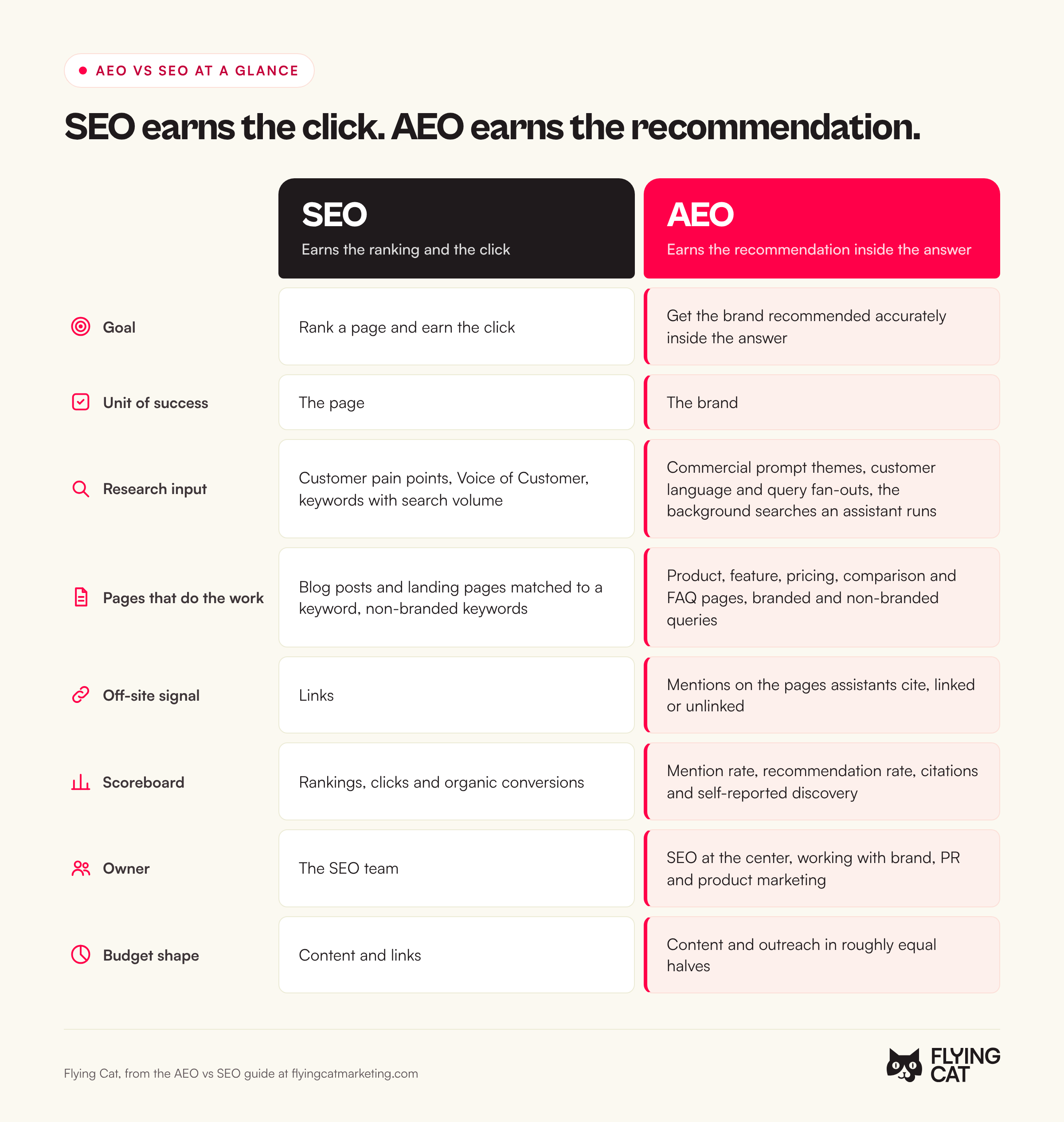
AEO vs SEO at a glance
| Factor | SEO | AEO |
|---|---|---|
| Goal | Rank a page and earn the click | Get the brand recommended accurately inside the answer |
| Unit of success | The page | The brand |
| Research input | Customer pain points, Voice of Customer, keywords with search volume | Commercial prompt themes, customer language and query fan-outs, the background searches an assistant runs |
| Pages that do the work | Blog posts and landing pages matched to a keyword, non-branded keywords | Product, feature, pricing, comparison and FAQ pages, branded and non-branded queries |
| Off-site signal | Links | Mentions on the pages assistants cite, linked or unlinked |
| Scoreboard | Rankings, clicks and organic conversions | Mention rate, recommendation rate, citations and self-reported discovery |
| Owner | The SEO team | SEO at the center, working with brand, PR and product marketing |
| Budget shape | Content and links | Content and outreach in roughly equal halves |
Where AEO came from
Although the acronyms are recent, the idea behind them is older than ChatGPT.
Answer engines arrived before chatbots
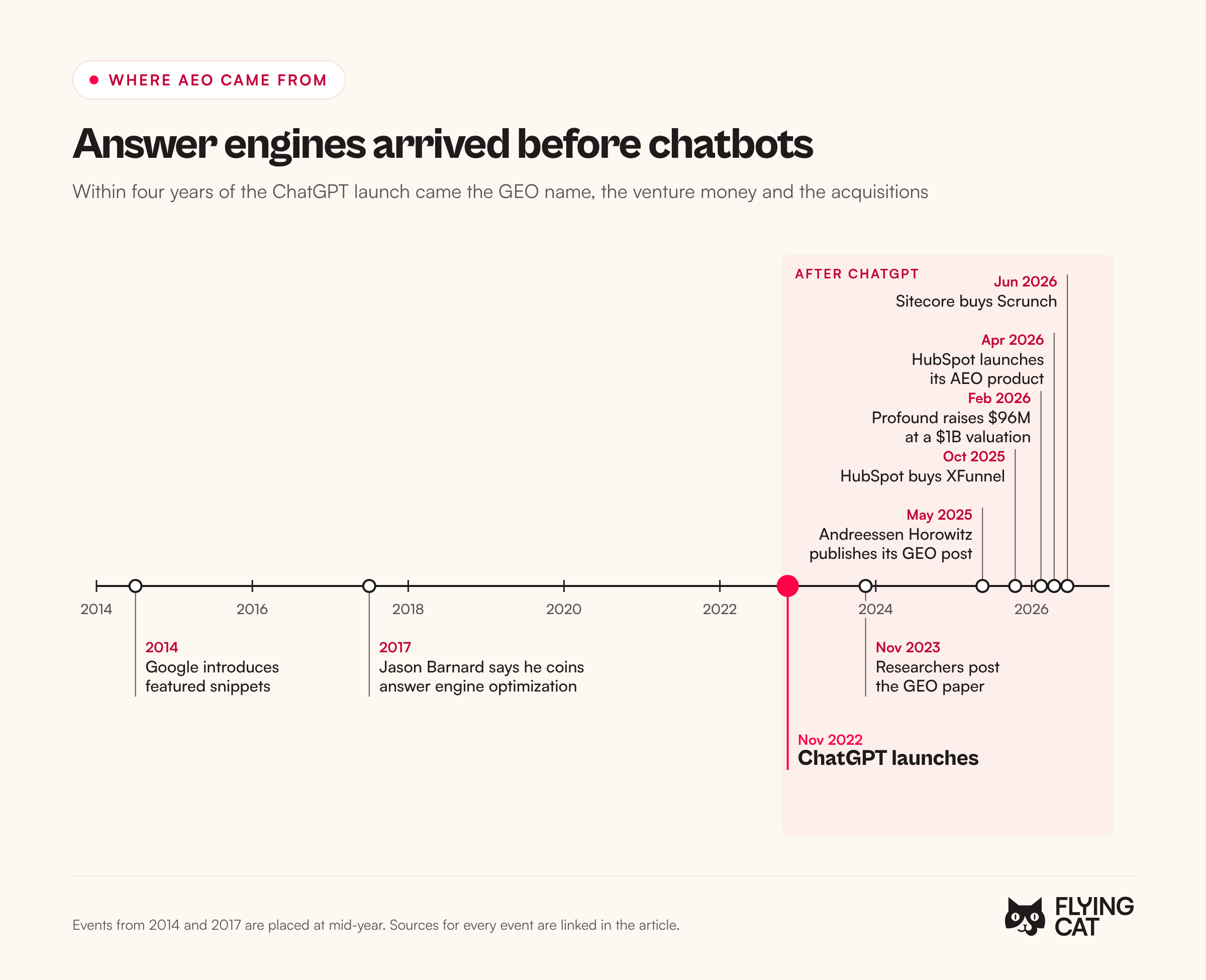
Search engines began answering questions directly well before anyone typed a prompt. Google introduced featured snippets, the boxed answers above the search results, in 2014, after which voice assistants spent several years reading single answers aloud in kitchens and cars.
Jason Barnard of the consultancy Kalicube says he coined the term answer engine optimization in 2017 and formalized it in 2018. By February of that year, the trade publication Search Engine Watch was already writing about the rise of answer engine optimization as a response to voice search. Even so, the term spent the next five years in a small corner of the SEO trade.
GEO began as an academic paper
That corner got crowded after ChatGPT launched in November 2022. Within months, Microsoft had put a chatbot into Bing, with Google testing AI answers in its own results soon after.
A second name followed a year later. On November 16, 2023, six researchers, half of them at Princeton, posted a paper that introduced generative engine optimization, or GEO. Their paper called the new systems generative engines and reported that certain changes to a page could raise its visibility in their answers by up to 40%. It was later accepted to KDD 2024, a data science conference.
Venture capital turned the paper into a category
For another eighteen months the acronym stayed mostly in the lab. It left in May 2025, when two partners at the venture firm Andreessen Horowitz published How Generative Engine Optimization (GEO) Rewrites the Rules of Search, a post that put the SEO market at more than $80 billion and named a handful of young GEO tools, Profound among them. That last detail drew criticism from Pedro Dias, an independent search consultant, who later argued in Search Engine Journal that the label had been manufactured from above, given that the firm is an investor in Profound.
Whatever the label's origins, money followed. Profound raised $96 million at a $1 billion valuation in February 2026, then reached $1.8 billion by September, according to Dealroom, which counted seven such startups with $472 million raised among them.
How SaaS companies responded
While investors saw a category, software companies first met the change as a loss. Early in 2025, reports circulated that HubSpot, the company that taught a generation of marketers to blog for traffic, had lost roughly 80% of the organic traffic to its blog. After acknowledging the reports, HubSpot entered the business itself. It bought the AEO startup XFunnel in October 2025, then launched its own AEO product in April 2026 while telling the market that its customers' organic traffic had fallen 27% in a year.
Larger platforms took the same route by acquisition. Adobe agreed to acquire Semrush for about $1.9 billion in late 2025, calling GEO a new growth channel alongside SEO. Sitecore followed in June 2026 by buying the AI visibility tool Scrunch.
Marketing teams, meanwhile, responded on their own blogs, with varying dignity. The Atlantic reported in June 2026 that Shopify's blog carried at least 60 ranked lists of e-commerce platforms, each with Shopify in first place.
Through all of this, Google has filed the whole business under SEO. Mike King of iPullRank sees money behind the argument over names. In his view, a new label such as AEO or GEO wins executive attention and its own budget, which SEO teams have long struggled to get.
Since the names changed faster than the work did, I use AEO and GEO interchangeably.
What your SEO program keeps doing
With that history in view, the first decision is easy to make. Your SEO program stays, because AEO depends on it.
Answer engines retrieve from the search index
To see why, consider how an AI assistant handles a buying question. Much like a diligent intern, it runs several searches in the background, reads the pages those searches return and writes up what it found. The industry calls that step retrieval, which is why a page that fails to be retrieved has little chance of shaping the answer.
In Google's guide to generative AI features, last updated in July 2026, says those features use Google's core ranking systems to retrieve pages from the Search index, which is Google's stored catalog of the web. The guide even calls the work "still SEO". Because that statement covers Google's products alone, I read it alongside data from the other engines.
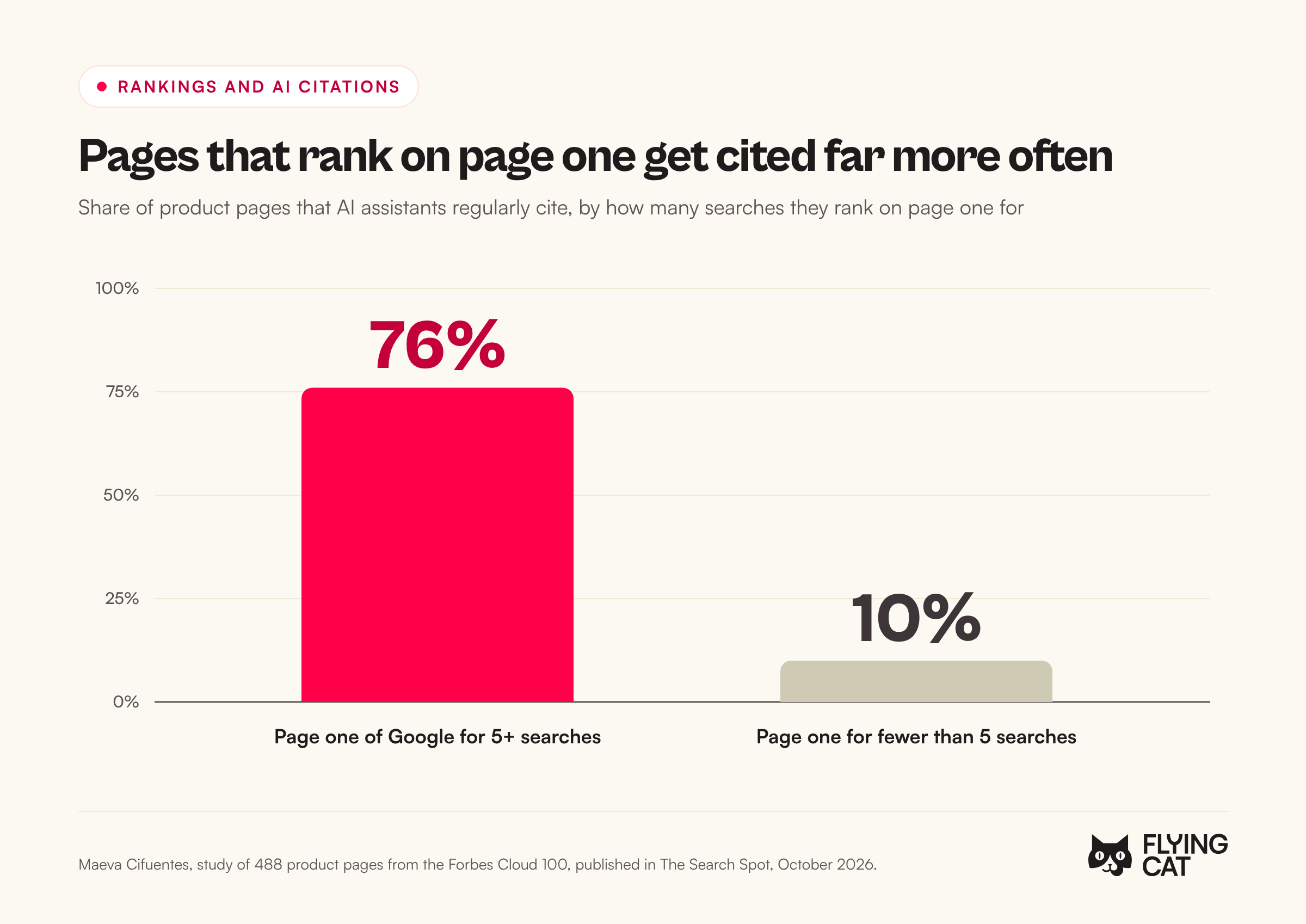
Last month, I studied 488 product pages from the Forbes Cloud 100, the magazine's annual ranking of private cloud software companies. Among the pages that ranked on page one of Google for five or more searches, AI assistants regularly cited 76%, while below that mark the figure fell to 10%. That made ranking the strongest predictor I measured, with a correlation of 0.81.
Because this is a correlation across large, well-known software brands, a smaller brand may see different numbers. Even so, the direction is clear enough to plan around.
Lily Ray makes the same argument in her March 2026 piece on GEO strategy, where she points out that AI search tools retrieve from search indexes, so organic ranking decides which pages are eligible for an AI answer.
AI crawlers have to reach and read your pages
Ranking only helps if the assistant can open the page, since it can cite only what it can fetch. Heavy JavaScript, a firewall rule or a default bot-blocking setting at your CDN, the network that delivers your site to visitors, can shut AI crawlers out while Googlebot strolls through.
Because Google rankings look healthy the whole time, I check access before any content work begins. Those checks are in our guide chapter on whether AI can read your site, with the fixes covered by our technical SEO service.
Fresh, specific, expert content still earns its place
Once a page is reachable, its substance decides the rest. Google's guide recommends content built on first-hand experience and a point of view of your own, over summaries of common knowledge. An assistant has little reason to cite the hundredth summary of something it already knows.
Freshness helps too, on the condition that the update changes the page's substance. Changing the date alone without any substantial update is black hat, and often penalized with new core updates.
So if AI visibility is a priority for you, keep your SEO budget intact, because cutting the base to fund AEO weakens both.
What AEO adds on top of SEO
Once a page ranks, we've done SEO. The AEO job ends when an assistant recommends your product by name, which is beyond the scope of work of SEO.
The brand replaces the page as the unit of success
In SEO, a page wins or loses. In AEO, the brand does.
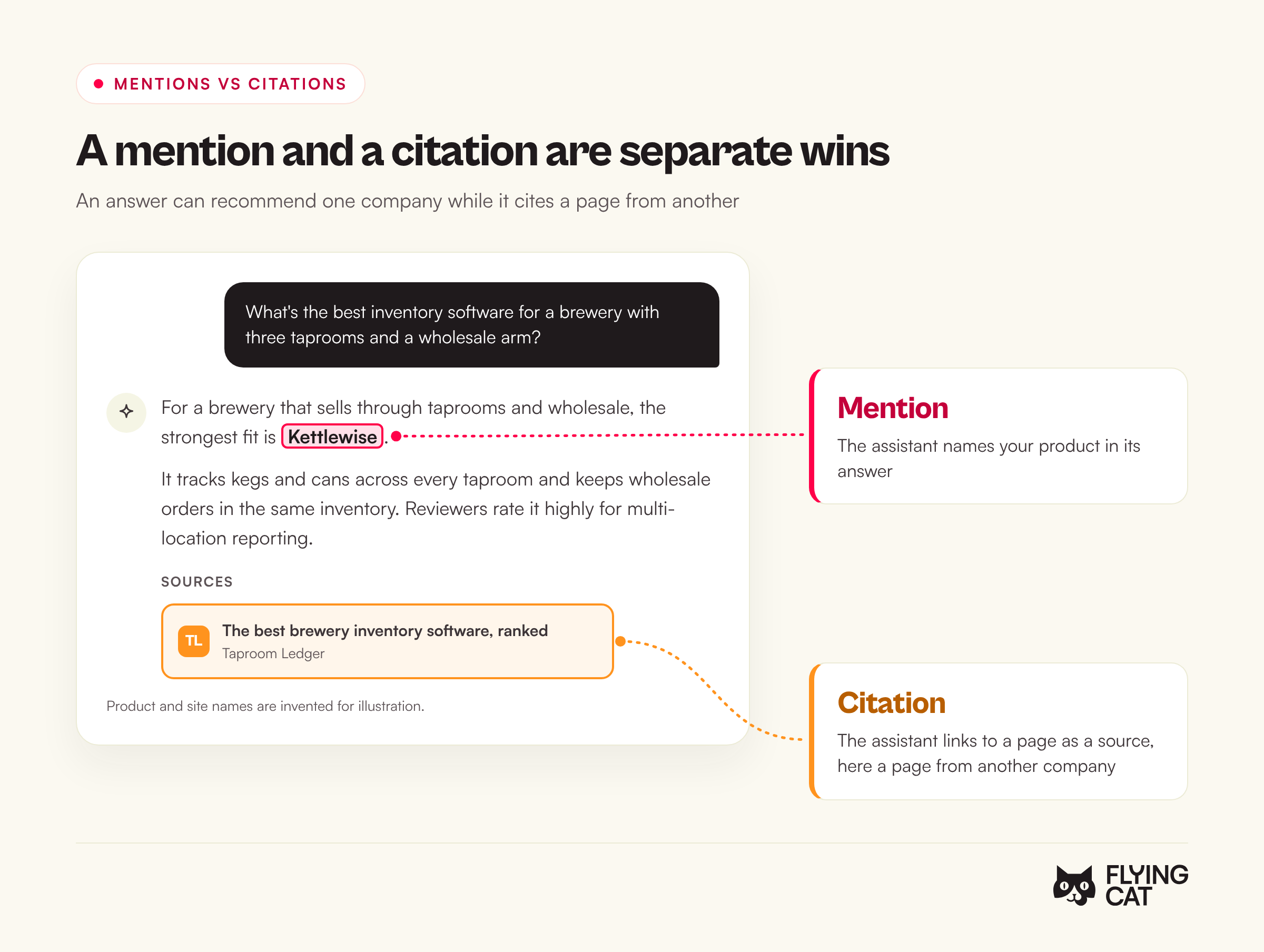
An assistant can reward a brand in ways that are easy to confuse. A mention means the assistant names your product in its answer, while a citation means the assistant links to a page as a source. Because the two travel separately, you can earn a mention without a citation when the assistant takes its recommendation from a review site. You can also earn a citation inside an answer that recommends your competitor, which leaves you catering a rival's wedding.
My client data shows how often they part ways. In 93,968 AI answers across five B2B SaaS clients, I looked at the answers that cited a vendor's own listicle, the "best tools" roundup a company publishes with itself on the list. Of those answers, 54.6% left that vendor unnamed. Lily Ray found a similar split in June 2026, when she checked 100 "best software" searches in Google's AI Overviews. Among the self-promotional listicles those answers cited, 69% came from brands the answer left out of its recommendations.
Even so, the cited listicle nearly tripled how often an answer named the vendor in my data, at 45.4% against 16.3% on the same questions. A citation is therefore a weak stand-in for a recommendation, which is why we track mentions and citations separately. On the mention side, an enterprise procurement platform we work with moved from 76% to 88% of ChatGPT category answers in four months.
Accuracy is the other thing AEO protects. An assistant will describe your product to buyers whether you invest or wait. Without AEO, that description comes entirely from third parties. For a product team that ships every month, a secondhand description goes stale fast.
Prompt research joins keyword research
Where keyword research used to constantly expand on variations and secondary keywords, I like to focus prompt research on top-level categories we want to be recommended for.
Buyers talk to an assistant the way they would talk to a colleague, at length and with context. A buyer might type "best inventory software for a brewery with three taprooms and a wholesale arm". Keyword tools show zero search volume for a query like that, though the buyer behind it is shopping in earnest. Most LLMs still don't show the exact prompts users write to search, and probably never will, given the private nature of chatting with your LLM.
So we track themes. A theme is a single buyer need, tracked as a single commercial prompt, with every rewording of that need counted as the same prompt. Our guide chapters on prompt research and query fan-out explain how we build the set.
I read the results as a trend. When SparkToro and Gumshoe ran 2,961 tests in January 2026, ChatGPT and Google's AI returned the same list of brands less than once in 100 runs. Rand Fishkin, SparkToro's cofounder, concluded that a ranking position inside an AI answer is unreliable. He also found that a different number is reasonable to track, which is the share of answers naming a brand, measured across many prompts and many runs. That share is what we report.
Product pages carry more of the load than blog posts
Product, feature, pricing, comparison and FAQ pages do more of the work in AEO than blog posts do.
SEO programs grew up on educational blog content, the "what is" articles that once caught buyers early. AI assistants now answer those questions themselves. My view is that informational content was SEO for the past, unless the piece is product-focused or says something new.
The citation counts point the same way. When Otterly tallied 6.1 million citations across seven engines for its AI Search Index in September 2026, company-owned pages had earned 53.7% of them.
How you write those pages counts too. In my product page study, AI assistants regularly cited 46% of the pages whose headings describe the product, compared with 25% of the pages whose headings promise an outcome. The copy effect is modest next to ranking. Still, an assistant repeats plain facts, such as what the product is, what it costs and who it suits. A heading that promises faster growth hands it very little to repeat.
Comparison content belongs in this group, with a caution attached. In my 93,968-answer data set, listicles earned 60.9% of citations in Q3 2026, though my tracked prompts lean toward "best X" questions, which favors listicles from the start. Lily Ray's March piece puts excessive self-promotional listicles and excessive comparison pages on her list of tactics that can backfire. The operative word is excessive. We build the comparison page where the product has a fair claim to be on the list, then we stop.
Our published case studies show the shift in practice. D2L put the largest share of its content program behind comparison pages, alternatives pages and best-of roundups, using positioning its product marketers supplied. Between December 2025 and September 2026, D2L went from 12% to 33% of tracked AI answers. Leapsome swapped generic top-of-funnel topics for buying guides, implementation guides, checklists and templates, then saw its mentions in Google AI Overviews grow 5x from March to August 2025.
Consensus across the web counts for more than link volume
Link building in SEO aims for authority. AEO outreach aims for consensus, meaning the web describes your product the same way everywhere a buyer or an assistant looks.
When Ahrefs studied 75,000 brands in December 2025, branded web mentions correlated with AI visibility at 0.66 to 0.71. Domain Rating, the Ahrefs score for the strength of a site's links, correlated at 0.27 to 0.33.
So our outreach targets the specific roundups, review pages and industry publications that assistants already cite for a client's category. A single mention on a heavily cited list can shift visibility more than dozens of generic links. Links still support your Google rankings, which is why we run both kinds of outreach and track them separately, by the method in our off-site visibility chapter.
Relevance is the filter. Google's guide says that chasing inauthentic mentions helps less than it seems. We pursue the lists where the product belongs and pass on the ones that would list anyone.
Each AI engine cites different sources
ChatGPT, Perplexity and Google rarely cite the same pages for the same question. Kevin Indig's citation overlap analysis from May 2026 covered 20,000 prompts across ChatGPT, Perplexity and Google AI Overviews. For the same prompt, 91% of cited URLs appeared in a single engine, while 2.4% appeared in all three.
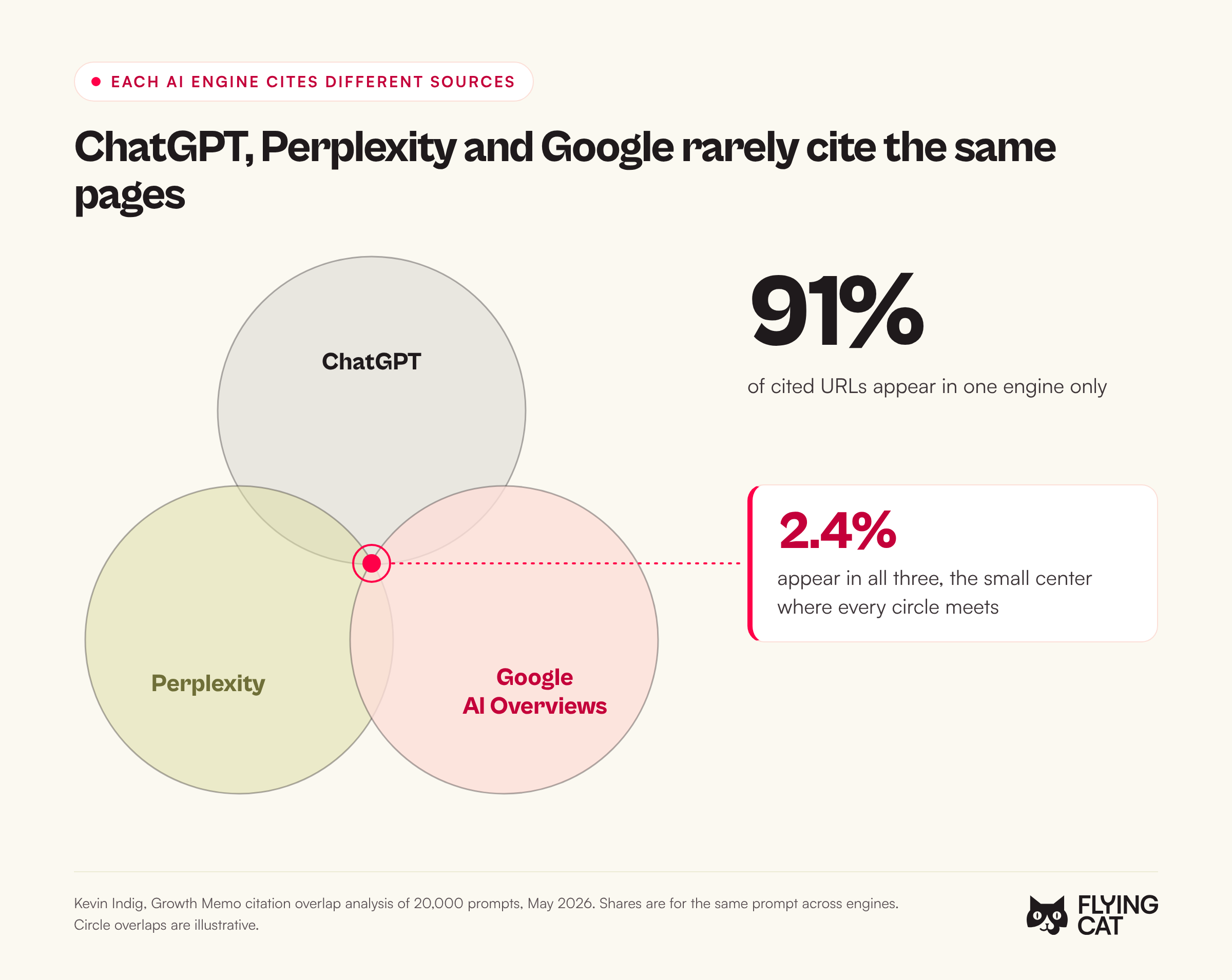
Ask your team or agency for results per engine. A blended score can hide the engine where you are missing.
AEO tactics the evidence says you can skip
A lot of the AEO advice ranking on Google today treats the work as a formatting exercise, a question of tags and files. I understand the appeal. A checklist is easier to buy than a reputation. The 2026 evidence is unkind to several items on that checklist.
- Adding schema to win citations showed almost nothing in testing. Schema is code that labels the parts of a page for machines, usually in a format called JSON-LD. Ahrefs tracked 1,885 pages that added it against 4,000 matched control pages in May 2026. ChatGPT and AI Mode citations moved by an amount indistinguishable from zero, while AI Overview citations dipped 4.6% for reasons that remain unclear. Structured data still earns rich results on Google, so keep it for that job.
- llms.txt files, which are plain-text summaries of a site written for AI models, go largely unread. Google's guide says Search ignores them. Ahrefs log data from May 2026 showed that 97% of the files received zero requests.
- Chopping pages into bite-sized chunks fixes a problem Google says you can ignore. Its guide says content needs zero special splitting and has zero ideal length. Write whole pages whose sections each state their claim plainly.
- Publishing a page for every prompt carries risk. Google's guide treats pages made at scale to manipulate AI responses as scaled content abuse, with enforcement picking up. Lily Ray counted four Google spam updates in 2026 against a single update in all of 2025.
Mike King of iPullRank dissents on chunking and llms.txt. He argues that passages built around a single idea retrieve better, since retrieval systems split pages into passages regardless, adding that llms.txt already helps with the systems that read it. On chunking, his position overlaps with Google's more than the dispute suggests, because a section that states a single claim plainly serves a reader and a retrieval system alike. On llms.txt, the Ahrefs logs keep the file near the bottom of my list.
The larger risk is the pattern Lily Ray keeps documenting, which is rapid growth followed by collapse. A tactic can work this quarter and cost you your rankings in the next. Lost rankings then take AI visibility down with them, since assistants retrieve from that same index.
Chapter one of our AEO guide lists the SEO habits to leave behind, which is the other half of this cleanup.
Who owns AEO
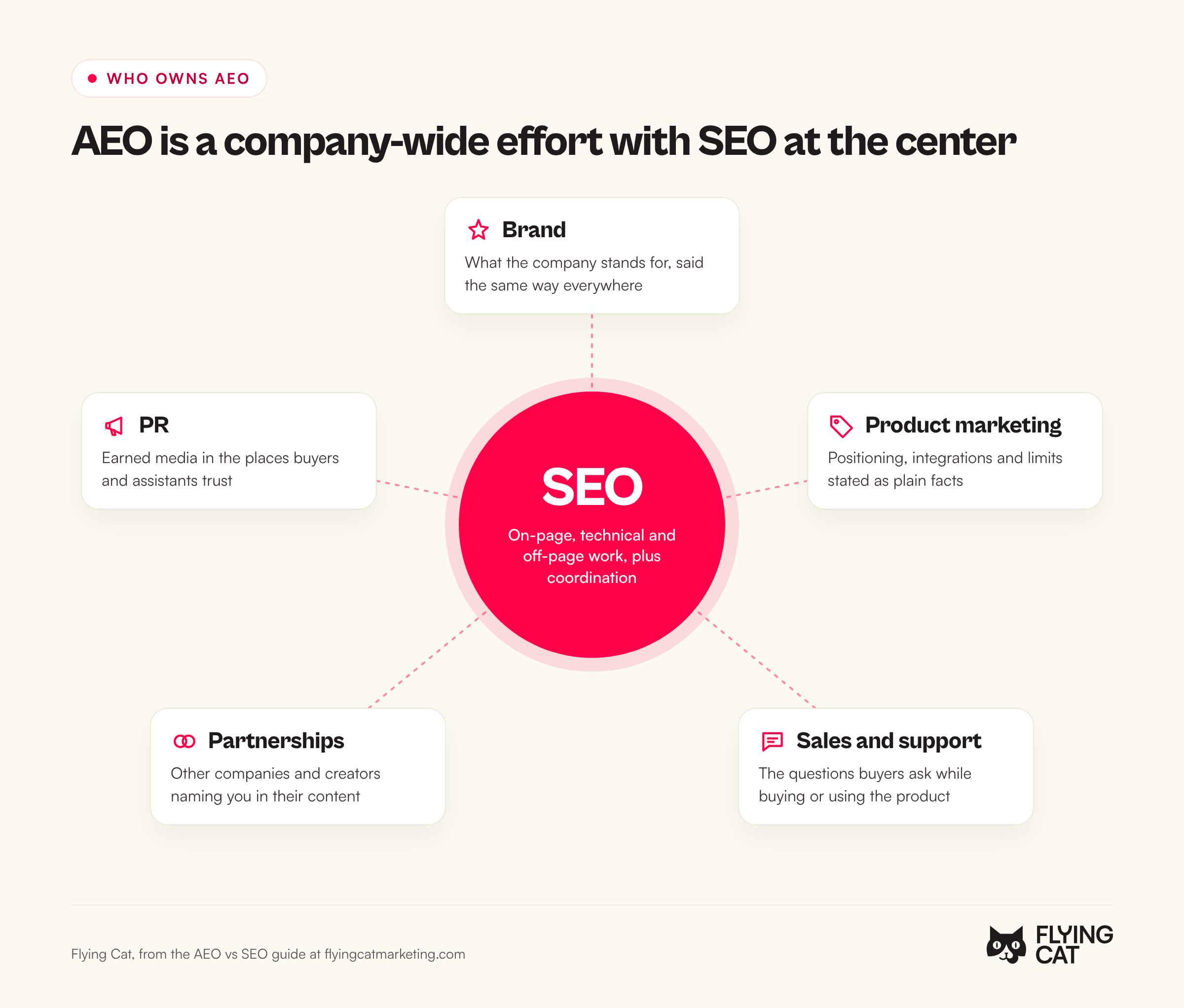
AEO is a company-wide effort with SEO at the center.
The center belongs to SEO because the work is still search. On-page, technical and off-page work all carry over. Consensus is the part an SEO team will struggle to deliver alone. An assistant builds its picture of you from your site, your reviews, your press coverage, your partners and your team's LinkedIn posts. Each of those surfaces answers to a different department, which is how a company can end up describing itself five different ways.
| Team | What it brings to AEO |
|---|---|
| SEO | On-page, technical and off-page work, plus coordination |
| Brand | What the company stands for, said the same way everywhere |
| PR | Earned media in the places buyers and assistants trust |
| Product marketing | Positioning, integrations, limits and differentiators stated as plain facts |
| Partnerships | Other relevant companies and creators naming you in their own content |
| Sales and support | The questions buyers ask while buying or using the product |
Smart people disagree on how far to take that. Google says optimizing for its AI features is still SEO. Mike King pushes back on that framing, arguing that the work needs its own budget, executive attention and cross-functional sponsorship. Eli Schwartz goes further, arguing that the brand team should own and pay for AEO while SEO keeps the site readable for machines.
I land between them. Brand and PR budgets belong in the plan, with SEO coordinating.
If you take a single action from this section, name the person who coordinates AEO across those teams. Then give your product managers a standing line to that person, since they know the integrations, the limits and the differentiators that an assistant needs to describe correctly.
How an AEO budget and retainer differ from SEO
An AEO retainer looks a lot like an SEO retainer whose scope has stretched past blog posts into product pages, every other page type, brand consistency and outreach. Prospects often ask me whether their current SEO agency can handle that stretch. Some agencies can.
On budget, I like to split AEO spend down the middle between content and outreach. Content covers the product, comparison and FAQ pages. Outreach covers placements on the pages assistants cite.
Vetting a provider takes more care than it used to. Some SEO agencies added AEO to the services page and kept working exactly as before. Some AEO newcomers have never run an SEO program, which means their tactics can sink a site's rankings, taking its AI visibility down with them.
The difference shows up quickly once you ask about process.
| Ask the agency | A strong answer covers |
|---|---|
| What changed in your process over the past two years, beyond the name of the service | Prompt research, product pages and outreach |
| How you choose prompts and how many runs stand behind each number you report | Themes built from buyer needs, with many runs behind every figure |
| Which pages you would rework first | Product, pricing and comparison pages, since a blog-only answer is a warning sign |
| How you pick outreach targets | The pages assistants already cite in your category, with mentions reported apart from links |
| Who makes the strategy calls | An expert who understands brand and marketing, with AI tools doing the data analysis |
Our comparison of AEO agencies for B2B goes deeper on vetting, while our GEO and AEO service page shows what a combined program includes.
Plan for patience on timing. AI mentions take a while to build, though I have seen early movement, meaning shifts in mention rate and citations, within the first two months.
How AEO measurement differs from SEO reporting
AEO reporting tracks how often AI assistants recommend your brand, where SEO reporting tracks rankings and clicks.
SEO told a fairly linear story, in which search volume predicted traffic, traffic predicted leads and a forecast followed. AEO is directional and correlational, because a buyer can shortlist you inside an answer and never click. The buyer from the opening of this article compared vendors inside ChatGPT before the first sales call.
Traffic alone undercounts that kind of research. When Ahrefs measured AI referral traffic in March 2026, it came to 0.28% of total traffic across 74,752 websites. That figure says very little about how many buyers read your name in an answer and came back later through a branded search.
At Flying Cat we report on a framework I call Recommendable, which tracks Reach, Recommend and Revenue across both Google and AI answers.
| Layer | On Google | In AI answers |
|---|---|---|
| Reach | Impressions, clicks and click-through rate | Citations and share of voice |
| Recommend | Rankings in positions 1 to 3 | Mention rate and recommendation rate |
| Revenue | Sign-ups, demos and new customers | Sign-ups, demos, new customers and self-reported discovery |
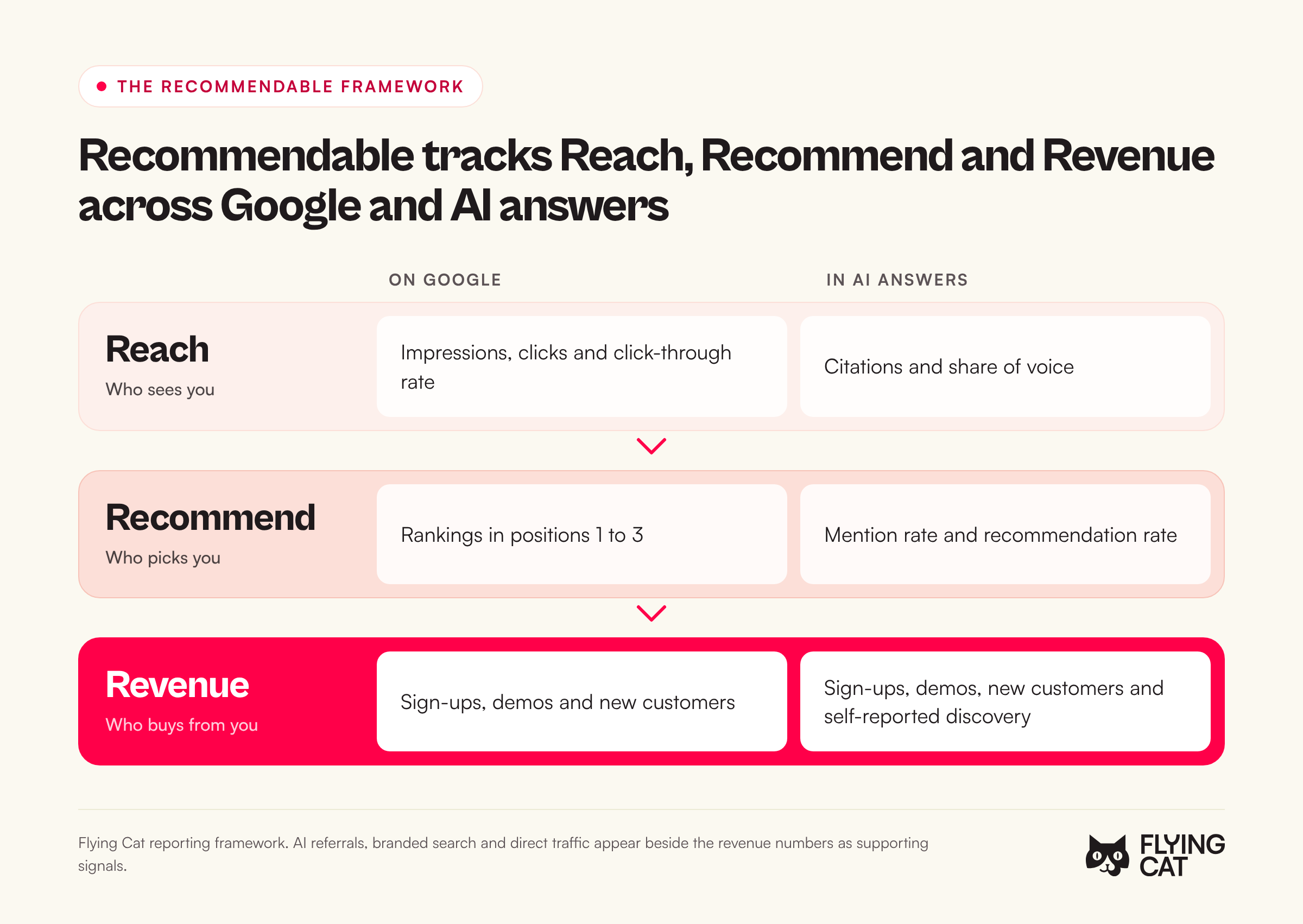
AI referrals, branded search and direct traffic act as supporting signals. We show them beside the revenue numbers as evidence, since AEO resists direct attribution.
The simplest attribution fix costs almost nothing. Add a "Where did you hear about us?" field to your demo and signup forms, with AI assistants as an option.
I also decline to forecast AEO with false precision. We set hypotheses, report monthly and review them every 90 days, a setup our measurement chapter covers in full.
How to run SEO and AEO as one program
For every new client of ours, a combined SEO and AEO program runs in roughly the same order.
- We start with access, because AI crawlers have to reach the pages that sell your product.
- Next we build the prompt set from the commercial keywords you and your competitors rank for, plus sales calls and support tickets.
- With the prompts in hand, we rework product, pricing and comparison pages before we commission new blog posts.
- We then write a fact sheet for the product, which lets us correct stale claims on your site first and on third-party pages second.
- From there we pursue mentions on the pages assistants already cite in your category.
- Throughout, we report monthly on Reach, Recommend and Revenue, with a hypothesis review every 90 days.
My advice for 2027 planning is to keep the SEO foundation, widen the job and report on recommendations.
Somewhere, the next buyer is already typing. The answer that comes back will be assembled from whatever your site and the rest of the web say about you that day.
I also publish new client data on AI search in The Search Spot.
Frequently asked questions
What is the difference between AEO and SEO?
SEO earns a page a ranking on Google and a click. AEO, short for answer engine optimization, earns a brand a recommendation inside an answer from ChatGPT, Gemini, Perplexity or Google's AI Mode. Both rely on the same search index, so AEO builds on SEO and adds product pages, consistent brand facts and third-party mentions.
Is AEO just SEO with a new name?
AEO builds on SEO and reaches further. The two share a foundation of rankings, technical access and expert content. AEO adds product-focused pages, consistent brand facts, third-party mentions and a new scoreboard.
Is AEO replacing SEO?
SEO remains the base that answer engines retrieve from, which is why Google's own guide describes optimizing for its AI features as still SEO. I expect the two to keep running as a single program.
Do you need both SEO and AEO?
You need both. AI assistants build their answers from search results, so pages that rank well on Google are far more likely to get cited. SEO gets your pages into the running, then AEO shapes what the answer says about your brand.
Is AEO better than SEO?
AEO and SEO do different jobs inside the same program. SEO gets your pages retrieved. AEO gets your product recommended once those pages are in the running.
Is AEO the same as GEO?
AEO, GEO and AI search optimization describe the same work, so I use the three names interchangeably.
Who coined the terms AEO and GEO?
Jason Barnard says he coined answer engine optimization in 2017, while generative engine optimization comes from a paper that six researchers posted in November 2023. From 2025 onward, venture investors and software vendors carried both names into the mainstream.
Can our current SEO agency handle AEO?
Some SEO agencies can handle AEO. To find out, ask what changed in their process for prompts, product pages and outreach, because an agency that changed the service name alone will struggle to move your mention rate.
How do you measure and forecast AEO?
We measure AEO by mention rate, recommendation rate and citations across a fixed prompt set, engine by engine, then connect those to sign-ups, demos and self-reported discovery. In place of precise forecasts, I run 90-day hypothesis reviews.
How long does AEO take to show results?
AEO mentions build over months, though I have seen early movement within the first two months of a program.
Founder and CEO of Flying Cat. She leads SEO and AI search strategy for B2B SaaS companies including D2L, Klaviyo, CoVet and Blue J.