NLP SEO: How Search Engines and AI Assistants Read Your Content
A practical NLP SEO guide for content marketers covering how Google and LLMs process language, how to write for them, useful tools and our brief template.
 Written by
Maeva Cifuentes
NLP SEO is the practice of writing content so that the language models behind Google Search and AI assistants can understand it, retrieve it and quote it. Those models read meaning. They compare a query with your page as a pattern of concepts. They also pull single passages out of your page to build an answer.
That changes the job of a content marketer more than any keyword tool update. When we rebuilt Bizzabo's content library around buyer questions and topic clusters, organic visits to its product and solutions pages grew 67% in four months, even though its non-branded clicks had fallen 23% year over year (Bizzabo case study). No keyword density target was involved. The pages simply covered what buyers needed to know, in language a machine could parse.
What NLP means for SEO
Natural language processing (NLP) is the branch of AI that lets computers interpret human language. It covers splitting text into tokens, parsing grammar, recognizing named entities such as companies and products, and working out what a sentence means in context.
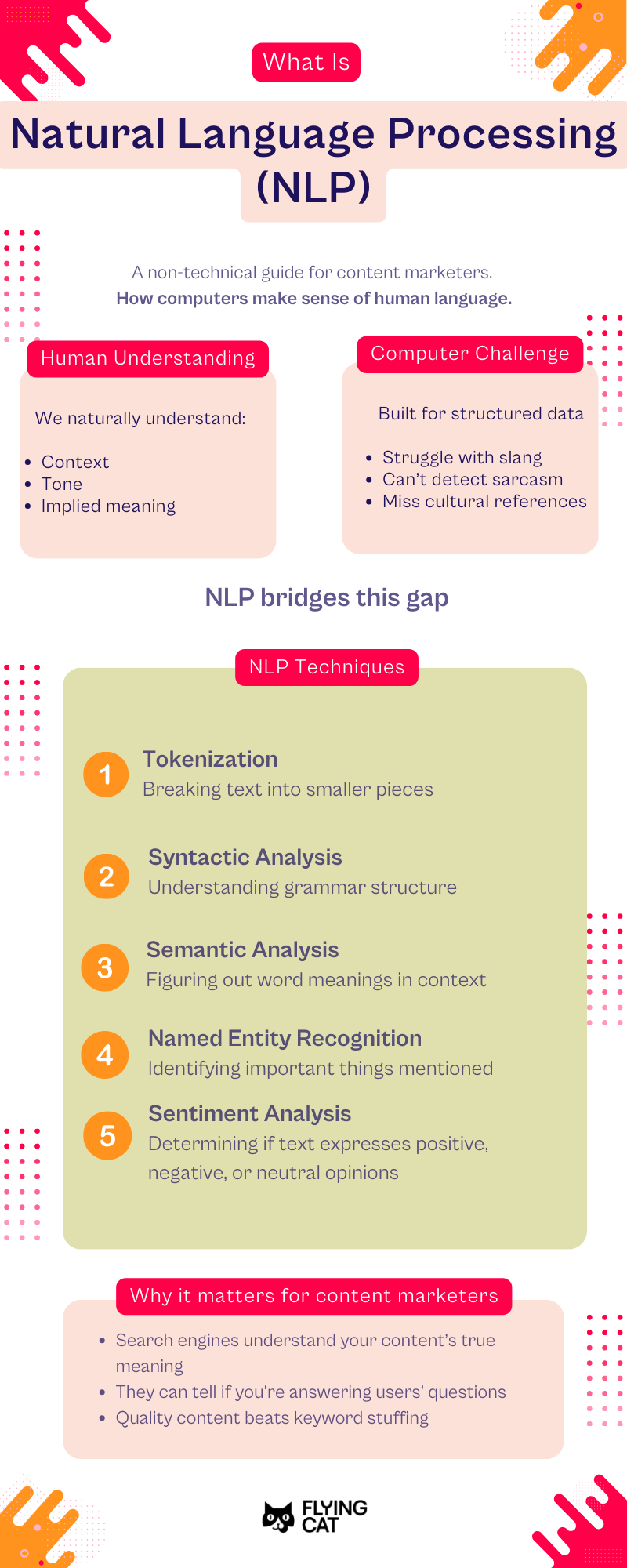
NLP shapes SEO at each stage of a search.
- Query understanding. Google works out what a searcher means, including the small words that change intent.
- Content understanding. Google and AI assistants work out what each page and each passage is about, and which entities it discusses.
- Answer generation. AI Overviews, AI Mode, ChatGPT, Perplexity and Gemini retrieve passages from many pages and write a single answer from them.
The first two have shaped rankings since 2015. The third is newer. It decides whether your brand gets named and your page gets cited when a buyer asks an assistant for help.
How Google's language systems developed
Google documents its main language systems in its guide to ranking systems. Each one moved Google further from literal keyword matching.
| System | Launched | What Google says it does |
|---|---|---|
| RankBrain | 2015 | Relates words to concepts, so a page can rank for a query without containing its exact terms |
| Neural matching | 2018 | Matches representations of concepts in queries with those in pages |
| BERT | 2019 | Understands how combinations of words express meaning and intent |
| Passage ranking | 2020 | Identifies individual sections of a page to judge relevance |
| MUM | 2021 | Understands and generates language, used for specific applications |
| Gemini in AI Overviews and AI Mode | 2024 to 2026 | Generates answers from many retrieved pages, using query fan-out |
A few details from Google's own announcements help put these in proportion. When Google introduced BERT in October 2019, it said the model would help with about one in ten US English searches. Its example was "2019 brazil traveler to usa need a visa", where the word "to" flips the meaning. A year later, Google said passage understanding would improve 7% of queries across all languages. Google announced MUM in May 2021 as 1,000 times more powerful than BERT and trained across 75 languages. Its ranking systems guide now states that MUM is not used for general ranking.
The practical lesson from that history is simple. Since 2019, Google has read your sentences the way a careful reader would. Since 2020, it has been able to rank one strong section of a long page.
How search engines and LLMs process content now
Embeddings, passage retrieval and query fan-out decide how content gets found in 2026. A content marketer needs the mental model behind each one, without the math.
Embeddings turn text into meaning
An embedding is a list of numbers that represents a piece of text. OpenAI's embeddings documentation describes it this way. Texts with related meaning sit close together. Unrelated texts sit far apart. Search, clustering and recommendations all run on that distance.
For a writer, this means a page about "reducing customer churn" sits near pages about retention, renewal rates and onboarding, even when the word "churn" is rare. It also means two of your own pages that say the same thing sit almost on top of each other. Check for that overlap before you commission another article on a topic you already cover.
Passages get retrieved one at a time
Google's passage ranking and every retrieval-augmented AI assistant work at the level of a section or paragraph. The system finds the passages closest to the question and judges each one on its own. A paragraph that only makes sense after reading the three above it is hard to retrieve. A paragraph that names its subject and answers one question in its first sentence is easy to retrieve.
Our guide to how answer engines work covers the retrieval step in more depth.
Query fan-out multiplies the questions you answer
Google's documentation on AI features in Search says AI Overviews and AI Mode may use a query fan-out technique. The system runs several related searches across subtopics and data sources, then finds more supporting pages while it writes the answer. Google's May 2025 AI Mode update described the same process as breaking a question into subtopics and issuing many queries at once. Google's Deep Search mode can issue hundreds of searches for a single report.
AI Mode now reaches a large audience. Google said at I/O in May 2026 that AI Mode passed 1 billion monthly active users, with AI Overviews above 2.5 billion.
ChatGPT, Gemini, Claude and Perplexity also search the web with their own rewritten sub-queries. DataForSEO added fan-out query data for all four to its LLM Responses API in December 2025. That is where we pull fan-out data for client briefs.
A buyer who asks "best procurement software for a 2,000-person manufacturer" may trigger sub-queries about ERP integrations, supplier onboarding, pricing models and implementation time. Your page can be retrieved for any of those. Your brand can also be missed if no page on your site answers them. Our query fan-out chapter explains how to research them.
NLP SEO myths to retire
An earlier version of this article repeated some of these tactics. They still circulate in NLP SEO advice.
LSI keywords
Latent semantic indexing is an information retrieval method from the 1980s. Google's John Mueller has said LSI keywords do not exist (Ahrefs summary of the claim and its history). The useful idea behind the label is related terms and entities. Call them that, and choose them because the reader needs them.
NLP keywords and keyword density
"NLP keywords" usually means the terms a content tool extracts from top-ranking pages. Those lists are a helpful checklist of subtopics. They become harmful when a writer treats them as a quota. Google's spam policies define keyword stuffing as filling a page with keywords to manipulate rankings. Google's helpful content guidance also says it has no preferred word count. A density target serves neither guideline.
FAQ schema as an NLP signal
Since August 2023, Google has shown FAQ rich results mainly for well-known government and health sites. Google's AI features page also says no special schema is needed to appear in AI Overviews or AI Mode. My own research points the same way. In a study of 488 product pages from 99 Forbes Cloud 100 companies, none of the 14 on-page traits I measured correlated with AI citations above 0.15 once rankings were held equal. FAQ schema, question-style headings, word count and product schema were all on that list.
Structured data still helps Google understand who you are and what a page describes, per its structured data introduction. Treat it as hygiene. It will not fix a page that says little.
Writing for an imagined algorithm
Older NLP advice told writers to use "relationship phrases" or to mimic Wikipedia so a model could build a knowledge graph. Modern models read ordinary prose well. Clear writing for a specific buyer is the optimization.
How to write content that NLP systems understand
We enforce the writing habits below in every Flying Cat brief and edit.
Cover the entities and questions the topic implies
Every topic implies a set of entities and questions. A page on AP automation software implies ERPs such as NetSuite and SAP, invoice capture, three-way matching, approval workflows, pricing models and implementation time. A buyer expects those. So do the models that compare your page with thousands of others.
Build that list from three sources. Use the top-ranking pages and the fan-out queries for the topic, then add the questions your sales team hears. Bizzabo's program started from sales-call insights that mapped the buyer's questions and evaluation triggers. New content followed buyer need over raw search volume (Bizzabo case study). Softr found its "client portal" opportunity through customer interviews, a term keyword tools had not surfaced (Softr case study).
If you want the site-wide view of how entities connect your brand, products and topics, read our guide to entity SEO. This page stays on the writing side.
Write descriptive copy over benefit-led copy
In the same study, which I published in my newsletter The Search Spot, descriptive copy correlated with AI citations at 0.19, while benefit-led copy correlated at negative 0.18. Among pages with 20 or more top-10 keywords, descriptive pages had a median of 101.5 citations against 34 for benefit-led pages (full findings). The findings are correlational. The sample covers large software brands.
The reason is mechanical. An assistant answering "does X integrate with NetSuite" needs a sentence that says X integrates with NetSuite. "Streamline your finance stack" gives it nothing to quote. The descriptive line below gives it several facts to work with.
- Benefit-led: "Empower your team to close the books faster."
- Descriptive: "Acme matches invoices to purchase orders and goods receipts automatically, syncs with NetSuite and SAP, and routes exceptions to an approver in Slack."
The second sentence contains four entities and three facts. Each can answer a sub-query. Pages that earned more citations than their rankings predicted also carried examples or templates 24% of the time, against 3% for under-performers.
Make every passage stand on its own
Because retrieval happens passage by passage, each section should work if it is the only thing a model reads.
- Open each section with a sentence that names the subject and answers the heading.
- Repeat the noun instead of "it" or "this" when a paragraph starts a new idea.
- Keep one idea per paragraph.
- Put numbers, names and dates in the sentence that makes the claim.
- Use tables for comparisons, since a table row is a self-contained fact.
Our on-site content chapter shows page-level examples.
Answer the fan-out selectively
Fan-out data can produce dozens of sub-queries per prompt. Building a page for each one creates thin, overlapping pages that sit next to each other in embedding space. We group sub-queries by intent and answer the closely related ones as sections of an existing page. A new page gets built only when a sub-query carries a distinct intent and commercial value.
Keep content current and specific
AI assistants favor recently updated pages, which is why D2L refreshes 10 to 15 pages a month. Traffic to pages in that refresh program doubled from March to May 2026 (D2L case study). A refresh at Flying Cat always changes the substance, such as new data, new screenshots or a new section. A date change alone does not count.
Choose topics AI cannot replace
Generic definitions are the content AI Overviews answer without a click. Leapsome swapped generic top-of-funnel topics for buying guides, implementation guides, checklists and templates. Its mentions in Google AI Overviews grew 5x from March to August 2025 (Leapsome case study).
NLP tools worth using in 2026
A small stack covers the NLP work in a content program. The table lists the categories we use and the job each one does.
| Tool | What it does | Use it for |
|---|---|---|
| Google Cloud Natural Language API | Returns the entities Google's public model detects in a text, with types and, for known entities, knowledge graph identifiers (documentation) | Checking that a draft clearly names the products, companies and concepts you intend |
| Content optimization tools such as Clearscope, Surfer or Frase | Grade a draft against the terms and subtopics in top-ranking pages | A subtopic checklist during editing, with no score target |
| Screaming Frog SEO Spider 22+ | Generates embeddings through OpenAI, Gemini or Ollama, then flags semantically similar pages and low-relevance outliers (release notes) | Finding near-duplicate pages before you write another one, and off-topic pages during an audit |
| DataForSEO LLM Responses and AI Mode data | Returns the fan-out queries ChatGPT, Gemini, Claude, Perplexity and Google run for a prompt | Building the question list for a brief |
| AI visibility trackers such as Scrunch | Track how often assistants name and cite you across a prompt set | Measuring whether the content earns mentions and citations |
| An LLM with web search | Shows how an assistant summarizes your page and which competitors it pulls in | A quick sanity check on a draft, never a final verdict |
The Natural Language API's demo is a good first test for any writer. Paste in a product page and look at the entities it detects. If your product name or core concepts are missing from the entity list, the copy is probably too vague.
Content scores need judgment. In our edits, chasing the last few points of a content score produces padded copy. Semantic similarity scores also need a human read, since two pages can look close in embedding space while serving different search intents.
How Flying Cat builds an NLP-informed brief
Our briefs handle the NLP work before a writer starts. For the enterprise procurement platform, we write briefs for the client's own freelance writer. Those briefs decide every heading, keyword placement, anchor text and internal link, so the writer does no research.
Every piece follows the same sequence.
- Topics are approved in a deliverables tracker, ranked by commercial intent and conversion potential.
- We pull the target keyword set, the top-ranking pages and the fan-out queries for the main prompts.
- We write the brief. The client approves the outline.
- A writer who knows the client's vertical drafts it, in English, French, German, Italian or Spanish as needed.
- The client approves the final draft with one round of edits.
- The piece is uploaded, internal links from existing posts are added, and it is tracked after publishing.
Brief template
Here is the template we use, filled in for an illustrative topic. The topic and product are examples. The fields are the ones in our briefs.
| Brief field | Example entry |
|---|---|
| Target query and intent | "best AP automation software for mid-market", commercial comparison |
| Reader | Controller or finance director at a 200 to 2,000-person company, evaluating vendors |
| Fan-out questions to answer | ERP integrations (NetSuite, SAP, Dynamics), pricing models, implementation time, three-way matching, approval routing, fraud controls |
| Entities to name | Product names, ERPs, invoice capture methods, compliance standards such as SOC 2 |
| Questions from sales | "Can it handle multi-entity?", "How long until we stop keying invoices?" |
| Section plan | One H2 per buyer question, each opening with a direct answer sentence |
| Descriptive facts required | Supported integrations, pricing structure, setup steps, limits |
| Proof assets | A worked example, a comparison table, one customer metric approved for publication |
| Internal links | Three to five, with descriptive anchors pointing to product and comparison pages |
| Copy rules | Features and specifics before benefits, no unexplained acronyms, one idea per paragraph |
What the results look like
In our programs, content built this way, supported by placements in the sources assistants cite, shows its first gains in AI visibility. D2L went from appearing in 12% to 33% of tracked AI answers between December 2025 and September 2026 (D2L case study). For an AI tax research platform for accountants, the citation rate across AI answers tripled from 7.8% to 23.9% in the first two months of our work. In the same window, its Google AI Mode citation rate went from 8.7% to 33.5%.
If you want this process run on your content, our content creation service covers briefs, writing and refreshes. Our GEO and AEO service adds prompt research, AI visibility tracking and placements. I lead the strategy on every account myself.
Founder and CEO of Flying Cat. She leads SEO and AI search strategy for B2B SaaS companies including D2L, Klaviyo, CoVet and Blue J.